The 2026 National Wilderness Skills Institute will have 5 “streams”:
- Combined – shared sessions for all participants
- Wilderness – learn more about wilderness character and minimum requirement analysis
- Wild & Scenic Rivers – sessions focus on history, river rangering, and restoration
- Backcountry Skills & Traditional Tools – learn new ways to sharpen your backcountry skills and tools
- North America Rangers – gathering of associations and resources to support rangers across the continent and around the globe
View recorded session from all prior years (2021-2025): https://wildernessskillsinstitute.org/nwsi/recordings/
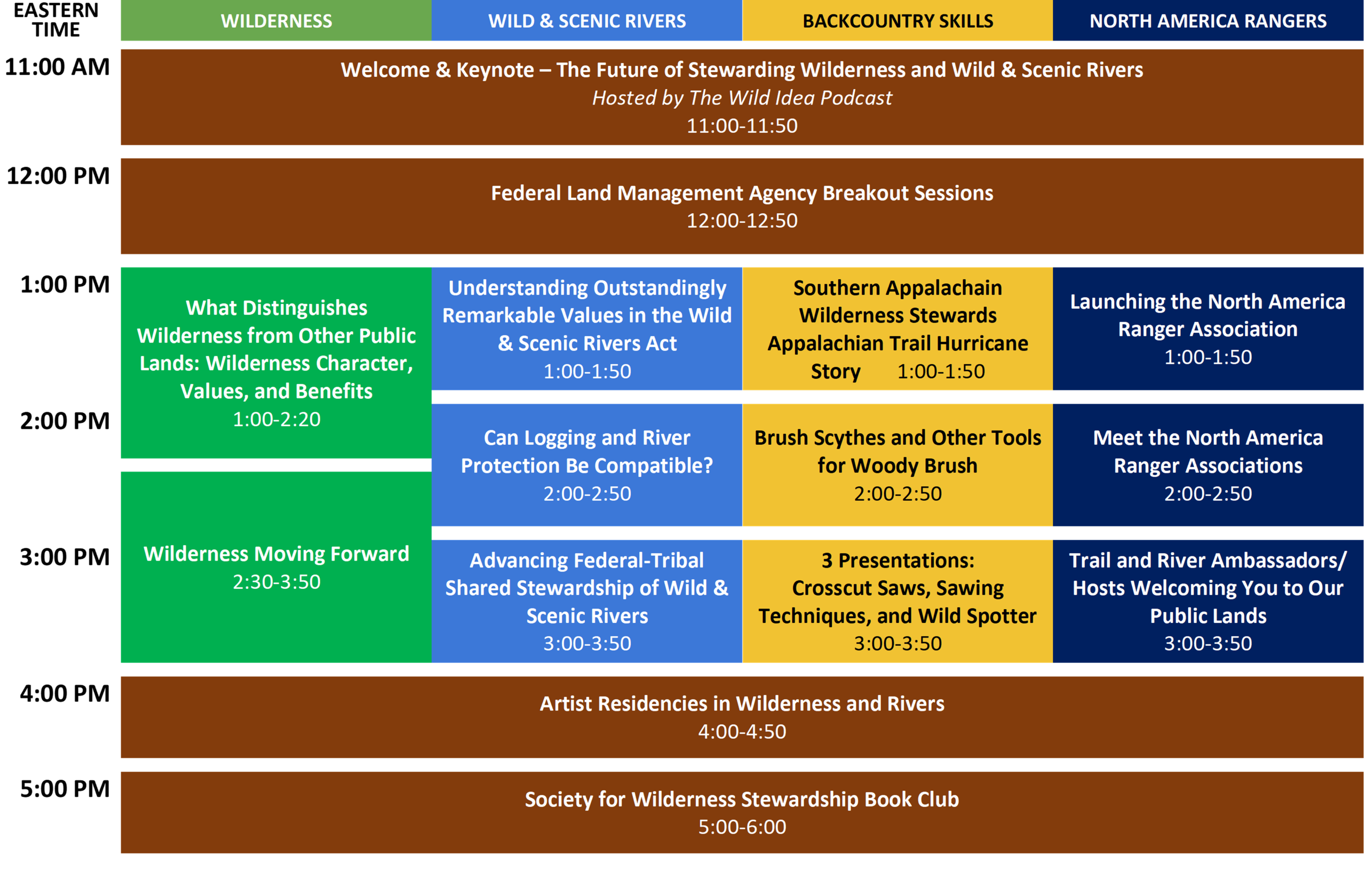
Wednesday, June 3rd Agenda:
(as of 5/9/2026)
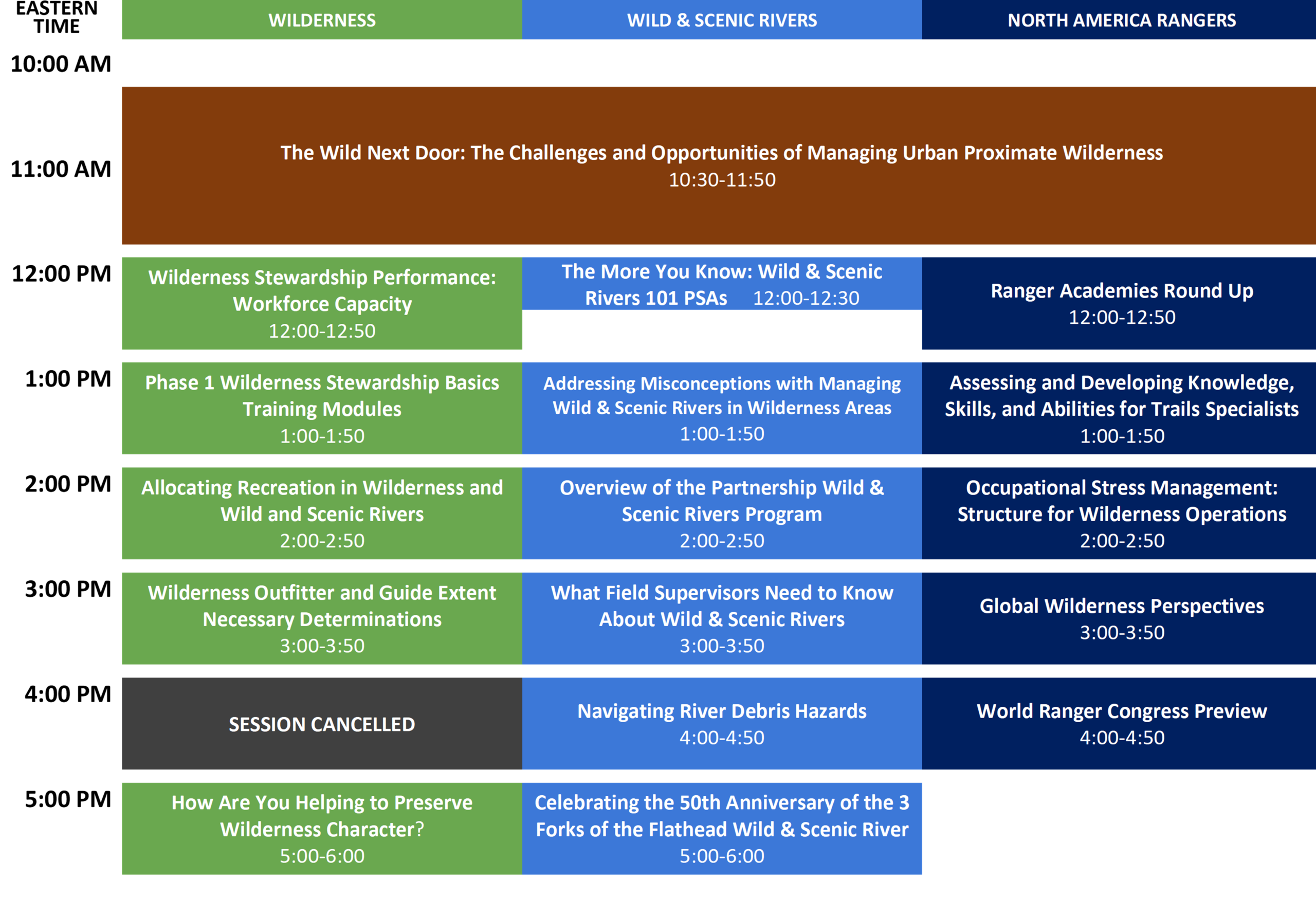
Thursday, June 4th Agenda:
(as of 6/3/2026)

- Welcome: Wednesday, June 3rd, 11:00 am ET
- Recording: https://youtu.be/p9gT4zBFfx0
- Description:
NWSI Core Team welcome message to kick off this year’s event
- Keynote – The Future of Stewarding Wilderness and Wild & Scenic Rivers: Wednesday, June 3rd, 11:00-11:50 am ET
- Recording: https://youtu.be/kgyhaZJFTIE
- Description:
Bill Hodge and Anders Reynolds from The Wild Idea Podcast will be joined by Meryl Harrell from Friends of the Forest Service and Lisa Ronald with American Rivers and the Wild &Scenic Rivers Coalition for a look into the future of stewarding our wilderness and wild & scenic rivers. The discussion will delve into the continuing and emerging challenges facing our system of wild places and the ways the community of stewards will rise to meet those challenges. There will be lessons we can learn from the past, tools that will help us engage new members of the community, and there will be an honest assessment of the state of our wild lands and waters today. - Hosts: The Wild Idea Podcast: https://thewildidea.com/
- Bill Hodge, co-host of The Wild Idea podcast, and co-founder of Wild Idea Media
- Anders Reynolds, co-host of The Wild Idea Podcast and Federal Legislative Director at the Southern Environmental Law Center
- Panelists:
- Meryl Harrell, Friends of the Forest Service
- Lisa Ronald, Northern Rockies Association Conservation Director, American Rivers
- Federal Agency Leadership Breakouts: Wednesday, June 3rd, 12:00-12:50 pm ET
- Not recorded
- Description:
Hear from your agency leadership on current priorities, challenges, and opportunities at the national level. Some will be available for an open discussion to collect feedback and listening to learn. - Facilitators:
- Bureau of Land Management: limited to current BLM employee attendance only
- National Park Service:
- Rob Burrows, Wilderness Training Manager, NPS representative to Arthur Carhart National Wilderness Center
- Erin Drake, Communications & Outreach Specialist, Wilderness Stewardship Division
- Corita Waters, Wild and Scenic Rivers System and Community River Partnerships
- U.S. Fish & Wildlife Service:
- Nick Kaczor, National Coordinator, Wilderness, Wild and Scenic Rivers
- U.S. Forest Service: (updated 5/27/2026)
- Gordie Blum, Public Benefits Director, Washington Office
- Steve Chesterton, Acting Director, Wilderness and Wild & Scenic Rivers, Washington Office
- Chief’s Wilderness Advisory Group
- Wilderness Information Management Steering Team
- Artists Residencies in Wilderness and Rivers: Wednesday, June 3rd, 4:00-5:00 pm ET
- Recording: https://youtu.be/TuLW_qOiunQ
- Description:
Join a round table discussion to learn about how artists residencies in work and how they can inspire your work as a wilderness and rivers steward - Panelists:
- Colter Pence, Wilderness, Wild & Scenic Rivers, and Trails Program Manager, Hungry Horse-Glacier View Ranger District, Flathead National Forest
- Barbara Lydon, Wilderness Specialist, Chugach National Forest
- Teresa Wenum, Conservation Education Specialist (retired), Flathead National Forest
- Rae Hutchinson, Youth Education and Rental Programs Manager, Mount Saint Helens Institute
- Society for Wilderness Stewardship’s Book Club: Wednesday, June 3rd, 5:00-6:00 pm ET
- Recording: https://youtu.be/LYlIps1qQMI
- Description:
- SWS employees have created a monthly wilderness book club! This session would invite NWSI participants to join for a special edition of our usual SWS book club. SWS will facilitate with discussion questions and break out groups. Join us for the first ever NWSI book club meet up!
- This session invites attendees to participate in a facilitated discussion and conversation about the book “Indian Creek Chronicles: A winter in the Bitterroot Wilderness” by Pete Fromm. This non-fiction read details the author’s 7-month adventure alone in a tent guarding salmon eggs as a college student in the 1970s. Facilitators encourage participants to read the book ahead of time but conversation topics will be broad enough that even folks who haven’t read it can participate. See you there!
- Facilitators: Society for Wilderness Stewardship
- Julia Cotter, Program Director
- Michelle Tanz, Program Coordinator and Wilderness Lead
- The Wild Next Door: The Challenges and Opportunities of Managing Urban Proximate Wilderness: Thursday, June 4th, 10:30-11:50 am ET
- Recording: https://youtu.be/p7PkqwMPMWw
- Description:
- The Aldo Leopold Wilderness Research Institute recently partnered with the Society for Wilderness Stewardship to direct and produce a 38-minute documentary film, entitled “The Wild Next Door: Between City Limits & Sacred Lands,” that explores the challenges and opportunities of managing urban proximate wilderness. With an in-depth look at the Alpine Lakes Wilderness located just an hour’s drive from Seattle, Washington, the film highlights the many perspectives of wilderness management in an alpine landscape, including those of current and former US Forest Service managers, Tribal council members, visitors, scientists, and nonprofit partners.
- In this session, the documentary will be followed by a 40-minute panel discussion featuring some of the film’s participants. A series of guiding questions will be posed to panelists to facilitate rich discussion around the issues facing urban proximate wilderness areas like the Alpine Lakes Wilderness and the potential paths forward to ensuring that these lands can continue to be loved without being “loved to death”.
- Facilitator:
- Kat Lyons, Director, Society for Wilderness Stewardship
- Panelists:
- Bob Dvorak, Professor of Recreation, Parks, and Leisure Services Administration, Central Michigan University & Editor-in-Chief of International Journal of Wilderness
- Suzanne Cable, Program Manager for Recreation, Trails, and Wilderness (retired), Okanogan-Wenatchee National Forest
- Emmi Lia, Research Scientist, University of Washington Recreation & Data Lab
- Mat Lyons, Executive Director, TREAD

- What Distinguishes Wilderness from Other Public Lands: Wilderness Character, Values, and Benefits: Wednesday, June 3rd, 1:00-2:20 pm ET
- Recording: https://youtu.be/bD6waRIlrMA
- Description:
- A short introduction to wilderness character from the Wilderness Act and Keeping It Wild 2 followed by 4 or 5 discussion stations to cover definitions, examples, and tensions for each of the tangible qualities in small groups.
- This is an interactive facilitated activity for participants to first consider and share a value that wilderness holds for them individually and then to connect individual values to the full ranges of benefits that wilderness provides to our country.
- Presenters:
- Rob Burrows, Wilderness Training Manager, National Park Service representative to Arthur Carhart National Wilderness Center
- Michelle Tanz, Program Coordinator and Wilderness Lead, Society for Wilderness Stewardship
- Jimmy Gaudry, Director, Arthur Carhart National Wilderness Training Center, U.S. Forest Service
- Wilderness Moving Forward: Wednesday, June 3rd, 2:30-3:50 pm ET
- session not recorded
- Description:
- Over the last three plus decades, the idea of wilderness (as articulated in the establishment of the National Wilderness Preservation System in 1964) has been subject to various ecological, historical, and philosophical critiques which have influenced how wilderness professionals and the general public understand wilderness. This session will explore the following questions:
- Does wilderness presuppose a problematic Human/Nature dualism?
- Were/are indigenous land use practices in opposition and/or in alignment with the National Wilderness Preservation System? and
- In a time of climate change and renewed recognition of many wilderness landscapes as the ancestral homelands of Indigenous peoples, might purposeful, careful tending of America’s wilderness ecosystems – a guardians and gardeners approach – help sustain them into the future?
- Speakers will provide a short presentation relating to these questions. After the presentation, we will have a facilitated discussion including questions from the audience.
- Over the last three plus decades, the idea of wilderness (as articulated in the establishment of the National Wilderness Preservation System in 1964) has been subject to various ecological, historical, and philosophical critiques which have influenced how wilderness professionals and the general public understand wilderness. This session will explore the following questions:
- Recommended Readings prior to attending this session:
- Boerigter, Clare E., Parks, Sean A., Long, Jonathan W., Coop, Jonnathan D., Armstrong, Melanie, Hankins, Don L. And Hoagland Serrra. 2025. Guardians and gardeners: Managing Wilderness for the twenty-first century. Bioscience https://academic.oup.com/bioscience/advance-article/doi/10.1093/biosci/biaf141/8249321?utm_source=authortollfreelink&utm_campaign=bioscience&utm_medium=email&guestAccessKey=d7504f49-d864-415a-984a-e888a647a205
- Keeling, Paul. 2026. Wild Nature and the Pseudo-Problem of Human/Nature Dualism. Environmental Ethics Vol.48, Issue 1, Spring 2026.
- Falson, Edward K., and Cashat-Schilling, Nohham R., 2025. Wilderness, Indigenous land zones and regionality in North American Forest. The Ecological Citizen https://www.ecologicalcitizen.net/pdfs/epub-150.pdf
- Facilitator:
- Dan Abbe, U.S. Forest Service Representative (retired), Arthur Carhart National Wilderness Training Center
- Panelists:
- Paul Keeling; Independent scholar, researcher, and writer in the philosophy of wilderness; BA Philosophy UC Berkeley, MS Philosophy University of Edinburgh
- Dr. Jaclyn Fox Rushing, Social Scientist, Aldo Leopold Wilderness Research Institute, U.S. Forest Service
- Erynn Castellanos, Education and Internship Specialist, Bob Marshall Wilderness Foundation
- Wilderness Stewardship Performance: Workforce Capacity: Thursday, June 4th, 12:00-12:50 pm ET
- Recording: https://youtu.be/KAdBxygeNWI
- Description:
This presentation will explore the Workforce Capacity element of Wilderness Stewardship Performance. Wilderness programs have reported on workforce capacity since at least 2011. What does an adequate workforce look like for your wilderness, and how do you objectively determine workforce needs? What do “effective incorporation” of volunteers and “significant accomplishments” look like?” This presentation will compile previous reports, provide a few strategies that were introduced over the years, and considerations when determining and advocating for your workforce needs. - Presenter:
- Jody Matz, Wilderness, Wild & Scenic Rivers Planner, Mt. Hood National Forest
- Phase 1 Wilderness Stewardship Basics Training Modules: Thursday, June 4th, 1:00-1:50 pm ET
- Recording: https://youtu.be/HNt3x9CZ8ac
- Description: The presentation will provide:
- An overview and history of the Wilderness Stewardship Basics Material
- Exposure to what is in the Wilderness Stewardship Basics Modules and a discussion of how the materials could be used
- Engagement with National Technology and Development and Arthur Carhart National Wilderness Training Center Staff Members
- A chance to ask questions and provide feedback on the project and its future
- Presenters:
- Thomas Sabol, Biological Scientist Project Manager, National Technology & Development Program, U.S. Forest Service
- Jimmy Gaudry, Director, Arthur Carhart National Wilderness Training Center, U.S. Forest Service
- Allocating Recreation in Wilderness and Wild & Scenic Rivers: Introducing a Research-Based Planning and Management Guidebook: Thursday, June 4th, 2:00-2:50 pm ET
- Recording: https://youtu.be/A0WSrBdB_iw
- Description:
- Federal recreation managers across the U.S. are often faced with the complex task of distributing recreational opportunities in areas where use is limited for one reason or another. In designated Wilderness or Wild & Scenic Rivers this complexity is magnified. Whether these opportunities are for limited campsites or multi-night river floats, managers must determine how to fairly and efficiently distribute, or allocate, these limited opportunities among the public. Calls for an allocation framework were first voiced as use limits began to be implemented at an increasing rate in the 1970s, and continued in the 1990s.
- This presentation serves as a formal introduction of a newly minted guidebook aiming to help recreation managers think through the nuances of distributing recreation opportunities with fairness and equity in the forefront and provide a recommended framework for allocation design in a river context. This guidebook was developed in 2023 and 2024 as a cooperative effort between the U.S. Forest Service, University of Montana, and University of Illinois. The information in this guidebook is supported by a systematic review of the recreation management literature, as well as qualitative interview data from 50 recreation managers across the U.S. We consider the pros and cons of several rationing techniques, with support of constructed case studies regarding allocation decisions, and discussions of balancing fair and efficient allocation outcomes. The primary goal of this guidebook is to provide a concise reference guide for managers and planners as they approach allocation decisions and to summarize the research insights on this topic to date.
- References:
- Allocating recreation with fairness at the forefront: A research-based planning and management guidebook : https://research.fs.usda.gov/treesearch/68808
- TreeSearch: https://research.fs.usda.gov/treesearch
- Data-informed support of applied visitor use management on public lands: https://research.fs.usda.gov/rmrs/projects/data-informed-support-applied-visitor-use-management-public-lands
- Presenter:
- Chris Armatas, Research Social Scientist, Aldo Leopold Wilderness Research Institute, U.S. Forest Service
- Wilderness Outfitter and Guide Extent Necessary Determinations: Thursday, June 4th, 3:00-3:50 pm
- Recording: https://youtu.be/3aAQ1ti5gR4
- Description:
Presenters will share a US Forest Service framework for doing an wilderness outfitter and guide determination and showcase how this was applied in the Bob Marshall Wilderness Complex. Participants in the presentation will gain an understanding of how they can tackle an extent necessary determination of their own. - Resources:
- Presenters:
- Colter Pence, Wilderness, Wild & Scenic Rivers, and Trails Program Manager, Hungry Horse-Glacier View Ranger District, Flathead National Forest
- Mary Ellen Emerick, Natural Resource Specialist (retired), Enterprise Program, U.S. Forest Service
- Designing Wilderness Portal Signage using Science-based Best Practices: SESSION CANCELLED
- Description:
- Trailhead signage represents one of the few sanctioned opportunities for managers to communicate with visitors at wilderness boundaries, yet it must simultaneously minimize visual intrusion, avoid information overload, and effectively promote low-impact behavior. This presentation builds from a participatory, visitor-centered study conducted at the Windsor Lake trailhead in the Mount Massive Wilderness (Colorado) that examined how recreationists prioritize information, interpret graphic design elements, and construct visual hierarchies when designing an “ideal” wilderness trailhead sign.
- Rather than testing a fixed signage intervention, wilderness visitors were invited to assemble their preferred trailhead bulletin board using modular design components representing different information types (e.g., maps, trail logistics, regulations, Leave No Trace practices, interpretive content) and graphic treatments (e.g., color, imagery, typography). Semi-structured interviews conducted during the assembly process revealed consistent tradeoffs between “needed” versus “wanted” information, strong preferences for map-centered visual hierarchies, and the importance of graphic strategies—such as photography, contrast, legibility, and agency branding—in capturing attention and supporting message retention. Findings extend prior wilderness communication research by explicitly integrating graphic design into Elaboration Likelihood Model–informed interpretations of attention, elaboration, and information overload.
- The presentation synthesizes these findings into a set of practical, evidence-based design principles for wilderness trailhead portals. These principles address information amount, information type, and information presentation, offering managers clear guidance on prioritizing content, organizing visual hierarchy, and applying graphic design strategies that support attention capture and cognitive elaboration without compromising wilderness character.
- Presenter:
- Adalyn Vargara, PhD student, University of Montana
- Description:
- How You Are Helping Preserve Wilderness Character?: Thursday, June 4th, 5:00-6:00 pm ET
- Recording: https://youtu.be/o-tP-mgd3bI
- Description:
Join us to brainstorm how your work in wilderness helps preserve wilderness character. Learn about the wide variety of wilderness stewardship work which results in wilderness character being preserved, including some creative connections. - Presenters:
- Colter Pence, Wilderness, Wild & Scenic Rivers, and Trails Program Manager, Hungry Horse-Glacier View Ranger District, Flathead National Forest
- Marissa Edwards, Virginia Program Manager, Society for Wilderness Stewardship

- Understanding Outstandingly Remarkable Values in the Wild & Scenic Rivers Act: Wednesday, June 3rd, 1:00-1:50 pm ET
- Recording: https://youtu.be/W1rzefExyTg
- Description:
The Congressional intent of the Wild & Scenic River Act (WSRA) as expressed in Sections 1(b) and 10(a) of the Act is to protect and enhance the three-fold purpose for which rivers are added to the National System. Free flowing water, water quality, and outstandingly remarkable values, also known as ORVs, are referred to together as the “river values”. Along with discussing what is meant by each of these river values, participants will spend much of the session learning more about the ORVs identified in the WSRA and explore the importance of documenting findings concerning ORVs. ORV identification can be a challenging part of the planning process and are often a bit misunderstood. We will go into detail about when ORVs are identified, what they must be, and where they can be located. - Presenter:
- John Campbell, Staff Officer; Recreation, Engineering, Lands & Special Uses, Chattahoochee-Oconee National Forest
- Protecting Rivers While Cutting Trees: Wednesday, June 3rd, 2:00-2:50 pm ET
- Recording: https://youtu.be/WMdy8XAU9nw
- Description:
American Rivers reviewed 50 years of timber harvest and fire mitigation projects that occurred within the Flathead Wild & Scenic River corridor, specifically the sections of the river with road access. We found that numerous logging and prescribed burning projects have modified much of this protected river corridor since its designation in 1976. Our work shows that the Wild & Scenic Rivers Act influences policy analysis and moderates, but does not prevent, activities taking place proximate to the river as a compromise to preserve important river values. Elements of Forest Service agency culture on this forest also influence how the demands of the Wild & Scenic Rivers Act are practically weighed when planning forest management projects. Using maps and GIS data informed by conversations with forest, fire, and river experts, the results of this project serve to inform decision makers striving to understand best practices to achieve successful compromises amid the divisive political and social forces currently influencing land management. - Resources: Protecting Rivers While Cutting Trees Report – https://www.americanrivers.org/reports
- Presenter:
- Lisa Ronald, Norther Rockies Associate Conservation Director, American Rivers
- Advancing Federal-Tribal Shared Stewardship of Wild & Scenic Rivers: Lessons Learned from Social Science Research: Wednesday, June 3rd, 3:00-3:50 pm ET
- Recording: https://youtu.be/bLiqowHmGcY
- Description:
- Over the past three decades, the US federal government has increasingly adopted shared stewardship arrangements with American Indian Tribes for land and water management. In 2022 the Interagency Wild & Scenic River (WSR) Tribal subcommittee began an effort to better understand challenges and opportunities for improved shared stewardship with Tribes in the WSR context. In this presentation, researchers from the Aldo Leopold Wilderness Research Institute share lessons learned from two case studies (the Eleven Point and Fossil Creek WSRs) where Federal and Tribal counterparts are working together to steward important riverways.
- Findings highlight that shared stewardship efforts and outcomes were built on a foundation of formal agreements that offered both a show of good faith and legal mechanisms that facilitated trust and accountability. Wild & Scenic River protections helped to transform Federal-Tribal relationships, for example when agency and Tribal representatives work together to identify and implement priority management objectives through the Comprehensive River Management (CRMP) planning and revision.
- Additionally, Federal-Tribal shared stewardship can improve WSR management because Tribal perspectives of WSRs, desired conditions, and Outstandingly Remarkable Values offer a more holistic approach to river management. Some managers thought that the general public may respect the WSR more and better protect the natural and cultural resources if perspectives and culture are incorporated in agency messaging. Despite the many challenges to sustaining Federal-Tribal relationships, this research shows that strengthened cultural competencies and capacity of federal agencies and representatives support effective shared stewardship of WSRs, with benefits extending beyond the scope of the CRMP.
- Resources:
- Comparative Case Study to Identify Opportunities to Strengthen Federal-Tribal Shared Stewardship of Wild and Scenic Rivers – https://www.rivers.gov/sites/rivers/files/2025-07/federal-tribal-shared-stewardship-report.pdf
- Presenter:
- Lauren Redmore, Research Social Scientist, Aldo Leopold Wilderness Research Institute, U.S. Forest Service
- The More You Know: Wild & Scenic Rivers 101 PSAs: Thursday, June 4th, 12:00-12:30 pm ET
- Recording: https://youtu.be/5t5I-VAd1Gk
- Description:
Keep your eyes and ears open at each of the wild & scenic rivers sessions during NWSI for a quick reel and pop quiz about Wild & Scenic Rivers. Building your wild & scenic rivers knowledge doesn’t have to take all day, you can start with a bite-sized introductory reel, then dive into a 3 minute WSR 101 video, hop on a webinar, and soon you’ll be joining us to talk all day about rivers. These bite-sized teaser reels will motivate staff to learn a little about wild & scenic rivers — we’ve got facts and fun! - Video Playlist: https://www.youtube.com/watch?v=daLyIy7PMmc&list=PLnCbDC5Lj9SdglLfV4eSU3cqJhW_0VJI9
- Presenters:
- Corita Waters, Wild & Scenic Rivers System and Community River Partnerships, National Park Service
- Nick Kaczor, National Wilderness & Wild and Scenic Rivers Coordinator, U.S. Fish & Wildlife Service
- Steve Chesterton, Acting Director, Wilderness and Wild & Scenic Rivers, Washington Office, U.S. Forest Service
- Lucy Nentwick, Wild & Scenic Rivers System and Community River Partnerships, National Park Service
- Addressing Misconceptions with Managing Wild & Scenic Rivers in Wilderness Areas: Thursday, June 4th, 1:00-1:50 pm ET
- Recording: https://youtu.be/Sd4CSSM3oY0
- Description:
Land Managers and Line Officers frequently have to make decisions about how to address a project on a Wild & Scenic River within Wilderness, but often don’t know or are confused by which law has more authority. This session will provide a basic overview of the Wild & Scenic Rivers Act and Wilderness Act and the language found in the laws that addresses project analysis. Actual past projects will be used as examples of how to work through the analysis process and how to incorporate the intent of each law. - Presenters:
- Eric Sandeno, National Wilderness and Wild & Scenic Rivers Information Manager (retired), Washington Office, U.S. Forest Service
- Mary Ellen Emerick, Natural Resource Specialist (retired), Enterprise Program, U.S. Forest Service
- Overview of the Partnership Wild & Scenic Rivers Program: Thursday, June 4th, 2:00-2:50 pm ET
- Recording: https://youtu.be/5RnaMkE63Wk
- Description:
Overview of the Partnership Wild & Scenic River Program history, mechanisms for success, and forecast for new rivers. Discussion of the Nationwide Rivers Inventory, Eligibility and Suitability, program funding, and envisioning the model in new places. - Presenters:
- Risa Shimoda, Executive Director, River Management Society
- Fred Akers, Operations Manager, Great Egg Harbor National Scenic and Recreational River
- What Field Supervisors Need to Know About Wild & Scenic Rivers: Thursday, June 4th, 3:00-3:50 pm ET
- Recording: https://youtu.be/4NQt3FVtNI0
- Description:
- How can federal employees in field leadership roles be effective in fulfilling their stewardship responsibilities for Wild & Scenic Rivers (WSRs) and other rivers? Whether 10 percent or 100 percent of a supervisor’s time is dedicated to river management, the complexity of the job requires certain knowledge, skills, and abilities while also utilizing staff expertise across a number of disciplines. Expertise needed for a supervisor may vary and the competency areas for managing designated WSRs and non-designated rivers are important to understand.
- In particular, eight technical core competency areas related to river management are critical to these positions: Wild & Scenic Rivers Act History, Law, Regulation and Policy; Other Relevant Laws, Policies and Tools for River Management; River Management Planning; River Management Field Skills; Visitor Use Management and Monitoring; Natural, Cultural and Recreational Resources Management and Monitoring; River Information Management Skills; Collaboration and Engagement Techniques. Representatives from three different federal agencies discuss what is needed to be an effective supervisor on a unit with river management responsibilities.
- Reference: Technical Core Competencies – River Management Specialists and Non-Specialists: https://rivers.gov/sites/rivers/files/2023-07/river-manager-core-competencies.pdf
- Presenters:
- Monica Zimmerman, Outdoor Recreation Planner, Bureau of Land Management
- Steve Chesterton, Acting Director, Wilderness and Wild & Scenic Rivers, Washington Office, U.S. Forest Service
- Susan Cook, former Niobrara River Superintendent, National Park Service
- Navigating River Debris Hazards: Thursday, June 4th 4:00-4:50 pm ET
- Recording: https://youtu.be/6YzJGUtcrBU
- Description:
Two systems to evaluate river debris hazards for specific river contexts will be shared. Information will include considering seasonal timing and accessibility along with navigable status. Participants will gain perspectives to inform their own river debris contexts. - Presenter:
- Jeff Hammond, Park Ranger and Swiftwater Rescue Instructor, Arkansas Headwaters Recreation Area, Colorado Parks and Wildlife
- Celebrating the 50th Anniversary of the 3 Forks of the Flathead Wild & Scenic River: Thursday, June 4th 5:00-6:00 pm ET
- Recording: https://youtu.be/7sDwYgW5vg4
- Description:
Join us to learn about the interesting story of how the 3 Forks of the Flathead River both influenced the concepts behind the Wild & Scenic Rivers Act and how river stewards are celebrating the 50th anniversary of its designation this year. - Presenters:
- MJ Crandall, District Recreation Staff, Flathead National Forest
- Sheena Pate, Executive Director, Flathead Rivers Alliance

- Southern Appalachian Wilderness Stewards Appalachian Trail Hurricane Story – Yes, Traditional Tools Can Rise to the Occasion!: Wednesday, June 3rd, 1:00-1:50 pm ET
- Recording: https://youtu.be/-ibJYbNGwKc
- Description:
A discussion on the process of cutting out the AT after Hurricane Helene. Folks said the work could only be done with chainsaws, we cleared the wilderness with crosscuts. - Presenters: Southern Appalachian Wilderness Stewards (SAWS)
- Kristy Ealdwine, Kentucky Volunteer Coordinator
- Kaitlin de Varona, Executive Director
- Scotty Bowman, Tennessee Program Manager
- Kacy Hirschfelt, Trail Specialist
- Brush Scythes and Other Tools for Woody Brush: Wednesday, June 3rd, 2:00-2:50 pm ET
- Recording: https://youtu.be/GN3tKRI3jFg
- Description:
Overgrowth of woody brush on remote and Wilderness trails can result in loss of these trails. Keeping woody brush (blackberry, blueberry, rhododendrons and mountain honey suckle) cut back and under control is a large task for trail crews and volunteers in the Southeastern Unites States. The presentation will discuss human powered tools for woody brush control. The presentation will highlight the brush scythe, which is a forgotten traditional tool. Long handle shears, loppers, hand saws and swing blades will also be discussed. The presentation, live and narrated PowerPoint, will describe the technology of brush scythes, their use and their maintenance. Resources for brush scythes and other woody brush tools will be provided. Recommended tools based on experience with their use will be included. - Presenter:
- Paul Dickens, Traditional Tool Trainer, Volunteer Crew Leader, Southern Appalachian Wilderness Stewards
- Types of Crosscut Saws for Trail Work: Wednesday, June 3rd, 3:00-3:25 pm ET
- Recording: https://youtu.be/bHYkFcVS5kk
- Description:
There are many styles, patterns and sizes of crosscut saw and each were designed for specific purposes when they were created. Trail crews often encounter a wide variety of logs sizes, types and conditions so careful selection of their saws can optimize their performance. This video discusses various saw types and designs for trail work. - Presenters:
- Erik Rademacher Fleitz, Pacific Southwest Crosscut Saw Program Coordinator, U.S. Forest Service
- Robert Parks, Sawyer Instructor and U.S. Forest Service Volunteer, Ventana Wilderness Alliance
- The Finer Points of Crosscut Sawing Technique: Wednesday, June 3rd, 3:25-3:35 pm ET
- Recording: https://youtu.be/4ymHZBr3yfI
- Description:
- Using the handles for ease and efficiency
- Body posture for range of motion and strength
- Some techniques for not getting stuck
- Presenter:
- Dolly Chapman, Chapman’s Sharp Crosscut Saws
- Wild Spotter: Empowering Stewards to Protect America’s Wild Places: Wednesday, June 3rd, 3:35-3:50 pm ET
- Recording: https://youtu.be/nKUDENRvckQ
- Description:
- Wild Spotter is a place-based invasive species detection initiative designed to support those who work in, manage, and enjoy America’s wilderness areas and wild rivers. Built on the mapping infrastructure of EDDMapS, Wild Spotter combines traditional field identification skills with modern mapping tools, allowing anyone—assisted by focused target species lists and species guides—to document invasive species encountered in the backcountry.
- This session explores how Wild Spotter strengthens wilderness stewardship by connecting people actively involved in the landscape with the managers responsible for protecting it. Participants will learn how the Wild Spotter platform enables rangers, volunteer managers, trail maintenance crews, and backcountry visitors to report invasive species sightings using a mobile app (with or without cell reception). Reports submitted through the app feed into EDDMapS, where subject matter experts review and triage submissions. Land managers receive notifications of verified reports and can use the data to support response efforts using traditional tools and removal methods.
- The presentation will also introduce the Invasive Species Ambassador Training program, which expands the skillsets of natural resource professionals by adding outreach, education, volunteer engagement, and awareness campaign-building strategies while connecting participants to a national network of stewardship professionals.
- Learn more at https://www.wildspotter.org
- Presenter:
- Chuck Bargeron, Director, Center for Invasive Species & Ecosystem Health, University of Georgia

- Launching the North America Ranger Association: Wednesday, June 3rd, 1:00-1:50 pm ET
- Recording: https://youtu.be/1y3Lswruj20
- Description:
- The objective of this project is to establish a North America Ranger Association to help organize and support rangers in North America. This process will be driven at the regional level with support from the International Ranger Federation (IRF) and other partners. The aim for year one will be to baseline our collective knowledge of North American Ranger Associations, create a shared vision and set out milestones for establishing the new association.
- The IRF believes that strong ranger associations are needed to improve IRF’s effectiveness and also to benefit the ranger on the ground. Ranger associations can be vehicles for the provision of legitimacy and credibility to the ranger profession, supporting members’ interests and those of rangers who are not yet members. Moreover, regional ranger associations are key bodies to understand the different contexts and challenges rangers face on the ground. Today, there are regional ranger associations around the globe with the exception of North America.
- The objective of this project is to establish a North America Ranger Association to help organize and support rangers in North America. This process will be driven at the regional level with support from the International Ranger Federation (IRF) and other partners. The aim for year one will be to baseline our collective knowledge of North American Ranger Associations, create a shared vision and set out milestones for establishing the new association.
- Presenters: International Ranger Association
- Mark Caughlan, North America Representative
- Mónica Malvido Alvarez, Federation Development Officer
- Meet the North America Ranger Associations: Wednesday, June 3rd, 2:00-2:50 pm ET
- Recording: https://youtu.be/rDq84-YdyJc
- Description:
Introduction to a few member associations of the International Ranger Federation found in North America - Presenters:
- International Ranger Federation – https://www.internationalrangers.org
- Florida Park Service Ranger Association – https://www.fpsra.org
- Association of National Park Rangers – https://www.anpr.org
- Tennessee Park Rangers Association – https://www.tpra.net
- Rocky Mountain Ranger Association – https://www.rockymountainrangerassociation.org
- California State Park Ranger Association – https://www.cspra.com
- Park Ranger Association of California – https://www.calranger.org
- Ranger Foundation – https://www.ranger.foundation
- Park Law Enforcement Association – https://www.parkranger.com
- Trail and River Ambassadors/ Hosts Welcoming You to Our Public Lands: Wednesday, June 3rd, 3:00-3:50 pm ET
- Recording: https://youtu.be/xCs-pSwK-tQ
- Description:
Learn about two showcase examples of volunteer trail and river ambassador/host programs that welcome and educate visitors on their public lands. Through the capacity boost of partner organizations that focus on recruiting and organizing volunteers, visitors are greeted and receive the positive influence of trained volunteers on how to safely and respectfully recreate. Participants in this presentation will gain ideas on how they can launch their own ambassador/host program. - Presenters:
- Sheena Pate, Executive Director, Flathead Rivers Alliance
- Fiona Garvin, Chair, Indian Peaks Wilderness Alliance
- Sara Raley, Vice Chair & Summer Patrol Coordinator, Indian Peaks Wilderness Alliance
- Colter Pence, Wilderness, Wild & Scenic Rivers, and Trails Program Manager, Hungry Horse-Glacier View Ranger District, Flathead National Forest
- Ranger Academies Round Up: Thursday, June 4th, 12:00-12:50 pm ET
- Recording: https://youtu.be/oymQ_WhZqK4
- Description:
At the start of the field season, wilderness and river managers, field rangers, and partner organizations come together in regions across the nation to learn new skills, share experiences, and connect with one another as they work together to preserve wilderness character or the outstandingly remarkable values of wild & scenic rivers. These gatherings have various names – wilderness ranger academies, river ranger rendezvous, or the most common, wilderness skills institutes (WSIs). In this presentation, learn about several flagship programs so you can make plans to participate in one yourself. - Presenters:
- Arthur Carhart National Wilderness Training Center: https://carhart.wilderness.net/
- Jimmy Gaudry, Director, U.S. Forest Service
- Southern Appalachians Wilderness Skills Institute: https://wildernessskillsinstitute.org/sawsi/
- Kristina Macaulay, Wilderness Program Manager, Southern Appalachian Wilderness Stewards
- California Interagency Wilderness Ranger Academy: https://www.wildernessstewardship.org/ca-ranger-academy-26
- Evan Topal, Wilderness and Wild & Scenic River Program Manager, Inyo National Forest
- Travis Mason, Acting Public Services Staff Officer, San Bernadino National Forest
- River Ranger Rendezvous: https://rms.memberclicks.net/river-ranger-rendezvous
- Cannon Colegrove, Recreation Manager, Montana Fish, Wildlife and Parks
- Risa Shimoda, Executive Director, River Management Society
- Lebanon Wilderness Ranger Academy: https://www.wolvesoflebanon.org/lwra/
- Samir Saliby, President/Director, Wolves of Lebanon
- Arthur Carhart National Wilderness Training Center: https://carhart.wilderness.net/
- Assessing and Developing Knowledge, Skills, and Abilities for Trails Specialists: Thursday, June 4th, 1:00-1:50 pm ET
- Recording: https://youtu.be/ZIIiO3uvveU
- Description:
- Learn about core competencies, knowledge, skills, and abilities (KSAs) needed for entry level trails specialist’s work, in order to develop a personal development and training plan, and then identify resources to develop those KSAs. This session will be shared in three modules:
- Review the Trails Technical Core Competencies for Wilderness Specialists,
- Assess your own trails KSAs,
- Learn about resources to further develop your KSAs.
- Learn about core competencies, knowledge, skills, and abilities (KSAs) needed for entry level trails specialist’s work, in order to develop a personal development and training plan, and then identify resources to develop those KSAs. This session will be shared in three modules:
- Resources:
- Trail Specialist Competencies Self Assessment Form:
- Presenters:
- Colter Pence, Wilderness, Wild & Scenic Rivers, and Trails Program Manager, Hungry Horse-Glacier View Ranger District, Flathead National Forest
- Matthew Able, Acting Assistant National Trail Program Manager, Washington Office, U.S. Forest Service
- Occupational Stress Management: Structure for Wilderness Operations: Thursday, June 4th, 2:00-2:50 pm ET
- Recording: https://youtu.be/5WQraSBz9Ok
- Description:
Due to the unpredictable nature of operating in dynamic environments, exposure to cumulative and traumatic stress is prevalent in outdoor professions. These exposures put personnel at risk for developing stress injuries, such as burnout and PTSD. This presentation introduces industry leading best practices for managing the risk of occupational stress injury in wilderness-based operations. Participants will gain an understanding of use of the Stress Continuum for proactive stress management and the Incident Support Pathway to provide structured support for personnel following potentially traumatic incidents. - Presenters:
- Josie McKee, Education Director, Responder Alliance – https://www.responderalliance.com
- Global Wilderness Perspectives – Germany: Thursday, June 4th, 3:00-3:50 pm ET
- Recording: https://youtu.be/o3ymJHSpZEg
- Description:
- One of the most valuable tools for advancing wilderness stewardship is learning from one another.
- As convener of the World Wilderness Congress, the WILD Foundation creates space for practitioners, policymakers, and communities to exchange knowledge and build relationships that extend beyond any single event. This session reflects that ongoing exchange, bringing together perspectives from Germany and the United States, where practitioners continue to engage in international dialogue and collaboration to explore approaches to wilderness conservation.
- Speakers from Germany will share insights from their work advancing wilderness stewardship, offering a perspective on how wilderness is being understood and supported within their national context. Building on this, speakers from both Germany and the United States will reflect on the value of international cooperation, how exchange across countries and systems can strengthen practice, inform decision-making, and inspire new pathways for conservation.
- USA-Germany Partnership on Wilderness: https://wildnisindeutschland.de/us-g-partnership/
- Moderator:
- Adam Hanson, Managing Director, Global Networks and Partnerships, WILD Foundation (Convener of the World Wilderness Congress)
- Presenters:
- Sebastian Brackhane, Federal Ministry for the Environment, Climate Action, Nature Conservation and Nuclear Safety (Germany)
- Jana Planek, WILDNIS, (Germany)
- Chris Armatas, Research Social Scientist, Aldo Leopold Wilderness Research Institute, U.S. Forest Service
- World Ranger Congress Preview: Thursday, June 4th, 4:00-4:50 pm ET
- Recording: https://youtu.be/nsuOhTzlojA
- Topics:
- A preview of the 2027 World Ranger Congress, April 19-27, 2027 in Puerto Iguazu, Misiones, Argentina, and how to participate.
- General info about the Congress – format, number of days, who attends, numbers, diversity, theme, key topics of discussion and objectives.
- Why this is a globally important Congress – highlighting the significant actions needed in the final 3-years before the expiry of the Kunming-Montreal Global Biodiversity Framework (GBF).
- Who should attend and why?
- Challenges and opportunities
- Intended outcomes.
- Presenters: International Ranger Federation
- Chris Galliers, President
- Jonathan Churcher, General Manager
- Andrew Davies, Secretary
- Monica Alverez, Federation Development Officer